While giving blood today and suffering through one of the most horrendous, bloodiest movies that I've had the displeasure to see, I considered how blood is represented in the world of video games. I mean, the horror of seeing a zombie rip into the neck of your best friend would be ruined if, instead of blood, rainbows came splurting out of the wound. "Now Rachel," you chide, "are you suggesting all games should have blood gushing out of every orifice?" Well, innocent question asker, I can certainly see why Player One is so enamored with your hopelessly objective observations. My point is, blood can be an integral part of relating violence to the audience if used in an appropriate and tasteful manner.
Blood and the Gamer
As gamers, we have all put in our share of sweat and tears into games (some more than others (I'm looking at you, Sly 2!)), but never is the gamer asked to bleed for the sake of getting that one high score. Now, I know that sometimes you can get some pretty bad callouses from rotating the joystick in Mario Party, and sometimes you get cramps when button mashing in Soul Calibur, but these mild pains are not comparable to the flesh wounds, decapitations, and horrible, fiery deaths that we subject our avatars to on a daily basis.
I like gruesome deaths just as much as the next gamer, but there is a certain line of decorum that a developer has to respect. Perhaps one of the only games that I've had to put down because of the sheer amount of gore present in it was No More Heroes. While this game is perfectly respectable in its own right, and I know several people who absolutely adore it, I just can't stomach it. There is just far too much blood flying through the air whenever I cut into someone with the beam katana. I feel as though I'm in some sort of macabre waterpark, where instead of being splashed with refreshing water, I'm instead assuaged by blood, with decapitated body parts raining down on my head instead of pool toys.
Now, I know that there are settings on games where you can turn down the gore setting, but I'm one of those purists that insist on enjoying the game at face value. Seeing someone hurl rainbows and bleed green jello will make me feel as though I'm playing some sort of possessed version of Billy Hatcher and the Giant Egg, where they expect you to believe that you can obtain fruit from the mutilated corpses of the foes that you crushed underneath a humongous egg.
Between these two extremes lie the developers that decided to use blood in a tasteful and almost artistic fashion. While the Silent Hill series boasts blood-soaked playing stages with some pretty gruesome motifs, they definitely use it as more of an artistic medium as opposed to a gross-out factor. During the course of the game, there is hardly any blood shown when you're relentlessly clubbing a monster, or when a monster is gnawing on your leg. The blood in these games is used instead as a continuing reminder of the incredible violence that has occurred in the town. What is especially interesting is the transformative effect that blood has when splattered all over a mundane building. You definitely have not lived until you've played through the hospital in Silent Hill 3 and have seen all of the walls turn into skin.
Finally, there are the many games like Dead Space, Red Dead Redemption, Uncharted, and Resident Evil which use blood in context with shooting and killing, but the effect is realistic and lacks the over-the-top gore-for-gore's-sake that No More Heroes flaunted. Instead, the blood presented in these games does not make the gamer walk away in disgust, but is a sobering experience that contributes to making the game world a far more realistic place than Blood: The Waterpark and Billy Hatcher.
So what do you guys think? Do you care how much blood is presented in a game, or are you more focused on other elements, like gameplay? I'd love to hear your opinions!
Monday, February 14, 2011
Happy Valentine's Day!
That's right, kids, it's that time of year again and love is in the air! So, what better way of celebrating this lovely day than by talking about some video game romance? Whether it's a couple of sims engaged in some WooHoo or two Final Fantasy characters making lovey eyes at each other in every (and I mean every) cut scene, romance is an integral part of most games. It's the driving force behind that ancient trope of "saving the princess" and defeating every foe along the way in order to do so. I mean, do you think that plumbers and keyblade masters just go off on long rescue missions because their lady in distress owes them five bucks? Love, folks. It makes the game disk go round.
"But Victoria!" you exclaim in distress, "What makes a romance the stuff of video game legend?" Honestly, you people just love to interrupt with your strangely appropriate and shamelessly leading questions. Every great relationship is unique to it's context, making it difficult to judge whether a romance adds or takes away from the story. However, believability is often a good indicator of a classy relationship.
Now, most of the time the authenticity of a love story is subjective. What may be believable in one scenario may be completely ridiculous in another and it is this individuality that makes the story interesting. Still, sometimes a love interest is just (to put it lightly) bad, no matter the context. We all know the type, that character that just grates on your nerves so much that you wonder what the other character could possibly be thinking. Usually, the designers will try to make up for the love interest's awful personality by making the couple "childhood friends," because everyone knows that you have to put up with someone's crappy personality if you grew up with them.
Sophia from Star Ocean 3 is a great example of this. Now, your mileage may vary but all her flouncing, pouting, and stamping her little foot immediately left a bad taste in my mouth. Then, to make matters worse, she had zero character development throughout the game. You expect me to believe that a smart kid like Fayt is meant to love this chick? No. Just, no. Is it too much to ask that a love interest be, I don't know, lovable?
Aigis from Persona 3, on the other hand, is one of my favorite love interests in all of video game history. Yes, she is a robot. Yes, that means no lady bits. No, I don't care a bit... and neither does the protagonist! True, it seems about as unlikely as a love story can get but these two make it work. While her character seems flat and (at the risk of stating the obvious) mechanical at the beginning, she (like all the characters in this game), undergoes a tremendous character growth that will leave you "d'aww"ing all over the place. The best thing is that the attraction is there and it makes sense and players find themselves rooting for it, despite the obstacles.
So, what do you guys think? Do you ship a pair so hardcore that it's mildly embarrassing? Let us know!
As mentioned last Wednesday, most RPGs suck. From the horrendous Baroque, to the god-awful Heroes of Might and Magic (Player One cannot stand this game, despite how great some have tried to tell her it is), when it comes to this type of game, very few of them are up to par. We here at 8-Bit Apples and Tea have deliberated as to why this is the case and have come to one, inescapable conclusion:
The best RPGs follow a specific formula, and the rest are crap.
Now you might be thinking, "Hey wait a second! Are you saying that every RPG should be a cookie cutter replica of every other in order to be good?" Calm yourself, reader, that's hardly what we're implying. Of course every game should be unique and we're all for originality. However, there are definite rules that should be adhered to when creating an RPG. Think of them more as guidelines that, if followed somewhat closely, should result in a fabulous playing experience. Granted, not every good RPG religiously followed every single one of these rules but the important thing is that they make up for it by excelling in the others.
Rule 1: An Aesthetically Pleasing Opening
Someone once said, "Don't judge a book by it's cover." Well, dear readers, we say, "Judge away!" The fact of the matter is, a well done opening sequence really sets the tone for the rest of the game. It should draw the player in and excite them for the oncoming game. There's nothing like the beauty of a well rendered intro coupled with an inspiring song, whether it be an orchestral piece or a Japanese pop song.
Kingdom Hearts is particularly well known for it's lovely openings. They're well done, and give an artistic insight to the game's actual plot without giving away any actual cut scenes. This subtle type of symbolism is always pleasant in intro videos because you don't feel as if you've already played the entire game without having even started, yet, you still have a good idea of what you're getting yourself into.
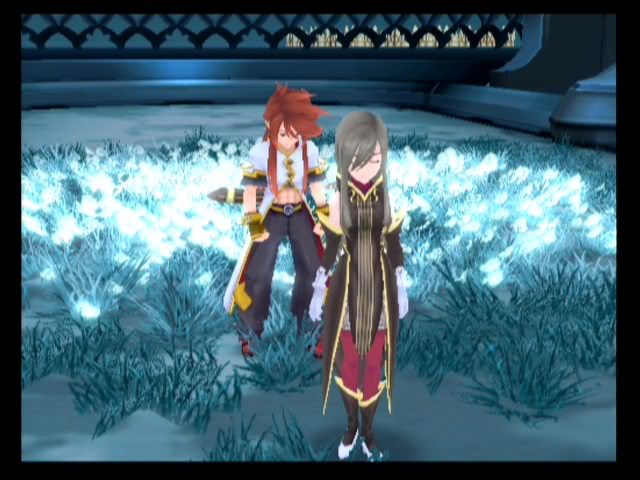
Once again, the opening to Tales of the Abyss doesn't use actual cut scenes or battle shots that leave you feeling like you've just had the whole game spoiled for you. The art style is pleasant and the upbeat music makes you feel like you could run outside and fight vicious monsters and psychotic martial arts teachers singlehandedly (you can't, trust me).
Rule 2: Outstandingly Entertaining Gameplay
Only a few gamers are willing to sit through a game with horrific gameplay, no matter how involving the storyline is. I (Player Two) have given up on several RPGs because of how inaccessible their control schemes are, or how horrendous their battle system is. It's just not possible to enjoy a game if you're constantly flipping through menus, or cursing your character's inability to follow orders, or complaining about how the boss just keeps scoring these cheap hits because you can't figure out which analoge stick actually moves your character.
Star Ocean 3 has a system that is very similar to Tales of the Abyss. These games feature non-linear encounters, where the players can freely assign special skills to buttons for use during battle. The very simple and precise nature of this battle system allows for the player to strategize when they need to (Arietta, I'm looking at you), but also gives the player the chance just to hack and slash when they're facing weak enemies. I think one of the standout features of this system is that 98% of the time I'm battling, and during 2% of the time that I'm in the menu, it's for easy tasks, such as assigning items for my characters to use. Kingdom Hearts 2 features a variation of this streamlined battle system.
Now I'm not going to discount games that utilize the menu during battle. Final Fantasy VII and Persona 3 are excellent examples of games that stick to this old formula, but offer enough variety and tension in their encounters to ensure that the player will continually hit the "Attack" button for hours on end. These games feature menus that are more complicated than games like Star Ocean or Tales of the Abyss, but simplistic enough that it's easy for the player to find whatever they need in a minimal amount of time. These systems are also incredibly handy for when the player wants to level grind, since pressing the X button with your foot while you play Pokemon on your DS is an incredibly easy task (I would know.)
Rule 3: New Twists on Old Themes
Rather than viewing these themes as clichés, we should perhaps see them as allegories of the RPG universe. Well of course you've seen the magic wielding/summoner love interest again and again, she is a symbol of what's keeping the main character from going off the deep end (except for Sophia, she's a symbol of all that is suck). These character and plot types are easily recognizable but, at the same time, are easily customizable to each RPG they make an appearance in.
Oh, yes, the protagonist's mysterious headache. Used in so many RPGs, this plot device is usually a sign of evil or, in some cases, shocking revelations. They range from mild migraine to head splitting horror but all are of equal importance to the plot as a whole. Aren't you curious now?
I (Player One) have always been a firm believer that babies are cuter when they come from a test tube. Luckily for me, this is the case for most RPG protagonists. Whether they're clones or simply genetically altered, main characters are always significantly cooler with a little gene manipulation.
Of course, who could forget the loyal and lovable best friend? It seems like most protagonists have them and Luke from Tales of the Abyss and Fayt from Star Ocean 3 certainly do. You know the type, blond, choker-wearing BAMFs with lady troubles. Who's complaining though? Not me, that's for sure.
Rule 4: Voices that Aren't Painful to Your Ears
An RPG can have amazing gameplay, stupendous characters, and beautiful graphics, but all of that is for nothing if the voice acting is terrible. I (Player Two) mean, who wants to listen to a protagonist that sounds like a three year old, a love interest who sounds like a chain-smoker, and a villain whose voice could shatter glass? I know that Player One and I certainly don't, and I'm pretty sure you don't either.
Now, when voice acting is good, it's amazing. Some of the most stand-out examples of voice acting for me would have to be from Tales of the Abyss. Although some of the one-line characters are not outstanding (one of Astor's burly guards sounds like a five-year-old girl for crying out loud!), the main cast is stupendous. Just listen to this:
How could you not love it? The Kingdom Hearts series and Persona 3 also have great voice acting casts.
For me, voice acting is one of the most essential aspects of an RPG. Voicing over script makes the dialogue come alive, and helps the player emphasize with the characters. Although Final Fantasy VII was an incredibly moving game, just think of the dramatic effect it could have achieved with the dialogue voiced over. Certainly hearing a character's last words or their comments on the last battle makes more of an impact on the gamer than just reading their reactions in the same tired text boxes.
So what do you guys think? Are there any elements of RPGs that you feel really work? Let us know! We'd love to hear about them.
Whether it's playing with a bunch of kittens, or debugging a house, or picking yet another's guard's pockets, all games have missions for you to complete. Now, there is a large gap between useful missions that actually assist in telling the story and missions that the developers threw in there for the sole purpose of driving you nuts lengthening a level.
The inspiration for this topic comes mainly from the hate/hate relationship that Player One and I currently have with Sly 2: Band of Thieves. Although, during Sly Cooper and the Thievius Raccoonus it often felt as though you were simply playing the same level over and over again (if I had to do another racing stint with Murray, I'm pretty sure I would have thrown my controller out the window), the platforming elements in the individual missions were varied enough that the overall experience was enjoyable. Not only that, but the superb (and incredibly difficult) variation of the final level of the game was enough for me to forgive the fact that throughout the game you would die if you got hit by an enemy (I mean, the game usually felt so bad for me that it would give me pity horseshoes, but even those went pretty quickly in the fight with Clockwerk.)
However, Sly 2 has tried to change up the elements that were established in the first game to add variation but have only succeeded in sapping the life out of the game. Every time I play Sly 2, I swear I lose about ten braincells, half my EXP, and 10 patience points. I believe most of the problem stems from the sheer amount of missions that the player is forced to do in order to complete a level. I'm all for trying to give a more open world feel to the games, but I would have appreciated a more comprehensive experience. Every task that I'm given to complete in the game feels monotonous. Instead of the vast amount of platforming in the first game, the focus in Sly 2 is on stealth and melee brawling. However, the stealth controls are clunky and the enemies, ridiculously overpowered, so in later levels, whenever you're caught (which is almost every single time you try to scale a roof), you're almost guaranteed to get killed (and/or demolished, destroyed, thrown off of the building into a river, and trampled by an elephant).
I also believe that some of the issues come from the useless segments where the player is forced to play as Murray or Bentley. Unlike the first game, where these were special experiences and guaranteed a complicated and rewarding variation from the usual platforming mundanity (save the racing segments. I hate the racing segments), in the second game these specialized levels feel like a form of punishment. I think it mostly has to do with the fact that most of Bentley's segments are ill-conceived minigames, and that Murray's brawling is only amusing the first time around. Perhaps one of the worst moments of the game, for me, was fighting a boss battle with Murray. The hippopotamus does not have the finesse of Sly and as a result his melee controls are incredibly hard to master for quick reactions to the boss's attacks. Eventually the encounter came down to trial and error, and I was only able to beat it when I had memorized everyone of the boss's attack patterns.
Player One and I have been valiantly struggling through this game for the past few weeks, and we haven't yet hit the halfway point. Personally, I think the major milestone that turned me off from the game was the fact that for several of the later bosses you have to go through two levels in order to finally defeat them. That means double the amount of useless missions, frustrating controls, and infuriating stealth sequences before you can even think about progressing to another stage of the game. It's just kind of ridiculous, if you ask me.
Essentially, the matter of beating Sly 2 has come down to a matter of pride. As a gamer, I want to prove that I'm worth my salt by beating this game, but I'm not going to enjoy the experience. Dear readers, have you ever played a game that you've beaten only out of sheer stubbornness? I would love to hear how you managed to brave the ordeal, since right now it looks like it's going to be a battle to the death with Sly 2, and I'm not sure if I'm going to win.
So, for the past few days, I’ve been playing an astonishing amount of Minecraft. Despite its simplistic graphics, I believe it’s one of the best games I’ve picked up in awhile. In fact, I’m pretty sure that higher level graphics would take just away from the fun. Now, this got me thinking about one of my favorite games of all time, Castlevania: Symphony of the Night. There’s no denying that this game is old, but it’s far from outdated. It was released for the PlayStation in 1997, which is actually pretty interesting considering that fully 3D games had already been around for a full year. So, it was risky for the creators to release a side scrolling, 2D platformer. Lucky for us gamers, they were brave souls, and we ended up with one of the best games out there for the PlayStation.
To be fair, I’ve never been one to buy into the idea that next generation games are better simply because they have better graphics. While I appreciate the beauty of a well rendered game, I think that a good game consists of far more than just its art style. To me, a great game is defined by its challenge, replay value, and sense of somewhat free exploration, while maintaining a solid end point to work for. All of these elements are present in SOTN, making a fantastic game even if its look is a bit basic. (Let's not forget its amazing soundtrack. They just don't make OSTs like that anymore...)
Now, the Castlevania franchise has made a few ill-advised forays into the three dimensional realm. Take, for instance, Castlevania: Curse of Darkness. (What a cheesy name! Well, I suppose 'Symphony of the Night' was sort of cheesy for a title... but at least it backed it up with a great game. Anyway, I digress.) They tried very hard to make this game pretty, with it's sparkling attacks (that let off more lens flare than the latest Star Trek movie) and highly detailed surroundings. Sadly, they didn't put as much effort into the rest of the game, leaving most who played it deeply dissatisfied. Look, guys, if I wanted a game with vampires and glitter, I'd just wait for the Twilight franchise to start producing games (you know it's just a matter of time).The moral of the story:
Good Graphics + Bad Gameplay = Bad Experience
Dated Graphics + Good Gameplay = Sexy Times
Yes, I think that sums it up nicely, don't you? Well, that about does it for this Monday. What do you guys think? More cowbell? Just kidding! Some feedback would be awesome, though. See you next time!
Let's face it, no matter how great the concept is or how beautifully the surroundings are rendered, nothing sucks the enjoyment out of a game like a flat, unlikeable main character. After all, how are you supposed to get behind someone you can't stand? I want to be able to root for a protagonist, not secretly wish for them to go die in a fire! (coughAnisecough ...I mean, what!? Who said that?) That's why, when it comes to some of our favorite games here at 8-Bit Apples and Tea, strong characters are a must. So, mainly because we're lazy and lists are easy, we've each decided to name our top five BAMFy characters, in no particular order. These characters were selected based on their ease of control, what they've brought to the plot of their respective games, and overall likability.
Protagonist – Persona 3
Alright, I know what you’re thinking, he doesn’t even talk! You know what? He doesn’t have to. Never has the phrase, “actions speak louder than words,” been so appropriate as it is when considering this character. From the moment he stepped off the train and wound up in the middle of the Dark Hour, he was unshakeable. With well over 100 summons in his arsenal, as well as the ability to use any weapon in the game (even a suction-cup bow and arrow!), he’s the most versatile fighter I’ve ever seen in an RPG. Not to mention, this character has class. If you’ve played through to the end, you know what I mean. There’s no drama, no tears, anger or bouts of hysterical laughter. Just a smooth, seamless end. Who needs another whiny, long winded main character? As if the RPG world didn’t have enough of them! I’ll take the smooth stylings of this kid any day.
Solid Snake - Metal Gear Solid
It doesn’t get much better than sneaking around as Solid Snake. Try to play Metal Gear Solid without feeling the urge to swan dive over barriers, creep around your cat when it’s not looking, and threaten others in a low, gravely voice. Everyone wishes they could be as cool as Solid Snake (just look at the cosplayers!), and for good reason. Anyone who didn’t feel badass while chucking grenades into a tank, setting off C4 charges, out sniping Sniper Wolf, and toughing out Revolver Ocelot’s torture just isn’t human. The truth is, any man who thinks that he can fool his enemies (and wolves (but not Metal Gear…unfortunately)) by hiding under a cardboard box in plain sight must be a BAMF.
Link – Legend of Zelda
Now, we can all appreciate a classic. The sheer legacy of this character should speak for itself. I mean, I know who I would want to carry out my quests if I were a princess in distress! His character concept was truly original and you’ve got to give him credit for his resourcefulness. Strapping a bomb to your arrow and then still managing to shoot it with flawless trajectory is quite a feat. Yet, Link seems to utilize this technique in every game as if it were as simple a task as putting on his hat.
Heather Mason - Silent Hill 3
Heather's badassery is understated, and it gradually dawns on you over the course of the game just how awesome she is. Initially, I thought Heather was just another one of those wimpy survival horror protagonists that whine and complain and never move in the direction you want them to (thanks a lot tank controls!), but I was proved how wrong I was as I got further into the game. I mean, the "Oh by the way, you're pregnant with a God" scene followed by the "I'm just going to swallow this fetus now" scene, and, you know, the whole beating up a God thing...If that's not badass enough for you, then I don't know what is.
Alucard – Castlevania: Symphony of the Night
Ah, Alucard, the powerful and rebellious half-vampire son of Dracula with a voice smoother than a cup of Foldgers. I really could just stop right here. Alas, I don’t think Player Two would be very amused. He scales every inch of Dracula’s castle, fighting every demon or creature he comes across (even Death himself!), until he finally finds and kills his father. Then, as if that weren’t enough, he does it all again… upside down! No, really, I think I’m done here.
Nathan Drake - Uncharted
Nathan Drake is the man who can do anything. Not only can he magically heal over thirty bullet wounds by hiding behind cover for fifteen seconds, but he also can climb everything. Helicopter? Check. Gigantic ice palace? Check. Train hanging precariously off a cliff? Check. He can do all of this with his bare hands; I envy his upper body strength. Playing as Drake makes you feel like the world’s greatest badass. “You saved a baby from a burning building today? Well I just climbed two hundred feet of machinery over a gigantic chasm just to pull a lever. No big deal.”
Thage – Eternal Poison
While not a well known RPG, I’m particularly fond of it. This is, in large part, because I truly enjoy the protagonist. Most females in RPG’s are supporting characters, usually playing the part of love interest. In no way does this describe Thage. In most cases, you accumulate your main party through a long and tedious introductory sequence. In a complete subversion of this, upon first beginning the game, Thage enslaves the last member of the main group using a dark spell to bind him to her will. As if this wasn’t BAMFy enough, you also have the option to have the entirety of your battle party consist of the enemies you’ve previously beaten into submission and captured.
Guy Cecil - Tales of the Abyss
“Enter the amazing Guy!” Guy makes his appearance in style. Not only does he jump off of a colossal landship, but in the process he also plucks the hostage out of enemy hands and deflects a bullet with his sword. One of the best fighters in the game, it is almost suicide not to have Guy in your party (as Player One and I have learned, since the computer loves switching him out with Anise during surprise encounters.) He has some of the best artes in the game, and an endearing personality and witty dialogue. If those don’t sound like the perfect elements for a BAMF, then seeing his mystic arte certainly will. Doesn’t getting engulfed in a phoenix made of flames just scream badass? I wish I could set myself on fire whenever I tackled people on the rugby pitch and not sustain any lasting injuries from the venture.
Lara Croft – Tomb Raider
Of course, I’m talking about the way she scaled her way onto the scene in the very first game of the series. Truly, when this game first came out for the PlayStation and Sega Saturn, it was far different from anything anyone had ever seen before. The unique style of platforming made it an iconic game for its time. Lara could take out bears, wolves, and mountain lions while traversing perilous terrain like the lovechild of an Olympian gymnast and a ninja, all while making it look easy! No matter what connotation this character has acquired over the years, she’ll always be one of my favorite grave robbers.
Jill Valentine - Resident Evil
Every time I blow the head off of a zombie in Resident Evil, it is usually followed by the phrase “Bitch, I’m Jill Motherfucking Valentine! What did you expect?!” Jill is perhaps the only character that I will loudly congratulate on screen for being such a badass (much to the chagrin of my brother), and why not? I mean, she has fought off hordes of zombies in three separate games, single-handedly defeated Nemesis, beat the snot out of Sheva, almost became a Jill Sandwich, and is the only protagonist to be vaccinated against the T-Virus. Everything she does just screams badass, but what else would you expect from the undisputed Master of Unlocking? Also, any character that can survive an opening this horrific and still be one of the most iconic video game characters deserves to be called a BAMF.
So what are your top video game BAMFs? Let us know!
Ripping the cellophane off of a brand new game is one of the best feelings in the world, but what happens afterword is the truly defining experience. The first few hours of gameplay are some of the most essential moments of any game, and what happens in them sets the tone for the game as a whole. Player One and I have learned this first hand in the past few weeks, since we've started three new RPGs and several adventure games since the term began. Therefore, I thought it prudent to chronicle my most recent impressions of what works in the opening moments of a game and what doesn't.
Like literature, some games begin in medias res, or in the thick of the action. The questions that are raised from the situation they are thrust into encourages the player to work through the tedious process of learning the controls so they can get to the main story. Uncharted 2 offers perhaps one of the greatest openings of this kind, with the opening scene focusing around protagonist Nathan Drake as he hangs bloody and beaten from a train car that is hanging precariously off a cliff. I mean, besides the obvious voyeuristic thrill of scaling a train car with your bare hands (which was pretty amazing, and rendered gorgeously), one of the key reasons why I stuck with the game was the simple question of 'Why?' Why was Drake bloody and beaten? How did he get himself into yet another one of these situations? Where exactly was Elena, and would she be making an appearance in this game? (The last one was definitely what worried me the most (much to the amusement of my brother, who bravely bore the brunt of my questions without giving a single thing away (even when I began to roll on the floor in agony at the sheer anticipation of seeing my favorite character (Player One can probably vividly imagine this one.))))
Another great way to start a game is to get the action started in the first few minutes of gameplay. Nothing makes you feel more like a badass than when you successfully gun down that first ganado in Resident Evil 4 (and then fling yourself out of the window to avoid the reinforcements, just because walking out the front door is decidedly lame.) Now, if this game had chosen to take the (markedly) horrible path of Kingdom Hearts 2, I am almost positive that I would have put it down immediately. Just imagine if you the player had to go through a tedious four hours of training before even seeing the first zombie (or zombie-like entity, for those purists)? What sort of horror game would that be? The gamer would be so familiar with the controls that they would feel like an old hand when confronted with the measly ganado, and not even blink as they promptly shot out his legs and roundhouse kicked him into the fireplace. A lot of suspense in the game comes from the gamer realizing in those first few terrifying moments of the encounter that they have no idea how to deal with the threat before them. Even with the onscreen prompts, I know I was decidedly panicked as I faced down my foe the first time that I played Resident Evil 4.
RPGs must take a different path than action/adventure games. The complicated set-up of menus, leveling up, special moves, and party building means that the gamer must suffer through hours of monotonous introduction before they can even begin the main portion of the game. Sometimes this investment is definitely worth the time and effort (and braincells lost, as the case may be (I'm looking at you, Kingdom Hearts 2)), but most of the time it's not. Let's face it, most RPGs suck. It's up to you to determine in the first few hours whether this game is worth your time, and the introduction is the ideal buffer zone. Granted, some games have horrible introductions, but the core gameplay is excellent once you get past the tedious assimilation of your party, complicated button explanations which break the forth wall (take a shot!), and gritting your teeth after you realize that you have to level up yet another group of characters so you don't get your ass handed to you when you fight sewer rats. (I mean seriously, sewer rats? Vaan, when did you ever think training against sewer rats was a good idea, and why do you suck so much at fighting them? They're rats!)
Tales of the Abyss is one of those aforementioned games. Getting through the introduction generally takes the player about twelve hours, and during this time you must brave a whiny protagonist, an awful AI for your main healer, one of those annoying child characters (yes, another one. Is it a requirement for RPGs to force you to have someone under the age of twelve in your party?), a ridiculously annoying protagonist (did I mention that one already? It definitely bears repeating), and a severe lack of characters to choose from to form your main party (in fact, you don't even get all of the characters until about eight to ten hours in.) However, if you grit your teeth and suffer through these arduous hardships, the game is absolutely spectacular. As soon as the main character cuts his hair and he decides to stop being a whiny, arrogant, infuriating brat, he becomes one of the most endearing characters in the game, and the player is hard pressed to come up with a good reason to stop playing, since the main storyline is excellent (which I can't discuss in length, since I might spoil Player One, who is just playing through this game for the first time.)
While the beginning of Tales of the Abyss was tedious, Kingdom Hearts 2 had an absolutely insufferable four hours of gameplay before the main story started. Don't get me wrong, I enjoyed playing Kingdom Hearts 2 immensely, I just had severe issues believing that anything could warrant sitting through the travesty that was the introductory segment of the game. Now, I know that it's important for the plot, and Roxas is an essential character, and that themes from the beginning permeate through the rest of the game, but really Square Enix? Really? Was it absolutely necessary for me to spend an hour of my life doing useless minigames to get enough money to get on the train to go to another section of town to do yet another useless series of quests, all for the sake of seeing a cutscene that has absolutely no value to the game? I think the most cerebral stimulation I got from the game in those first few hours was looking up at my ceiling and pondering my gaming choices. If I hadn't been ensured by my brother multiple times that Kingdom Hearts 2 was an excellent game, I would have given it up in those first few hours without a second thought.
Quite frankly, the difference between a good introduction and a bad one is quite startling, and this phenomenon is explained quite succinctly in this video:
So what do you think? Are bad introductions worth slogging through if you know the game is good? Or should you just put down the uninteresting game that you just started to instead play something that you know is good? What if the introduction to the game is good, but the rest of the game is awful? Let me know what you think!